
Who Should You Contact for Different Problems in India? A Complete Citizen's Guide
Introduction
Have you ever wondered whom to contact when your road is damaged, garbage is not collected, a government benefit has not arrived, a police complaint is not being acted upon, or a public project is delayed?
Many citizens approach their MLA, MP or another elected representative for every problem. Elected representatives can help raise concerns and seek action, but they do not personally control every department or public service.
The key is to understand which authority is responsible, where to file a complaint, and when to escalate the issue to an elected representative or a higher authority.
This guide explains whom to approach for common public problems in India, how to escalate unresolved complaints and which official channels you can use.
1. The basic rule: Who is responsible for your problem?
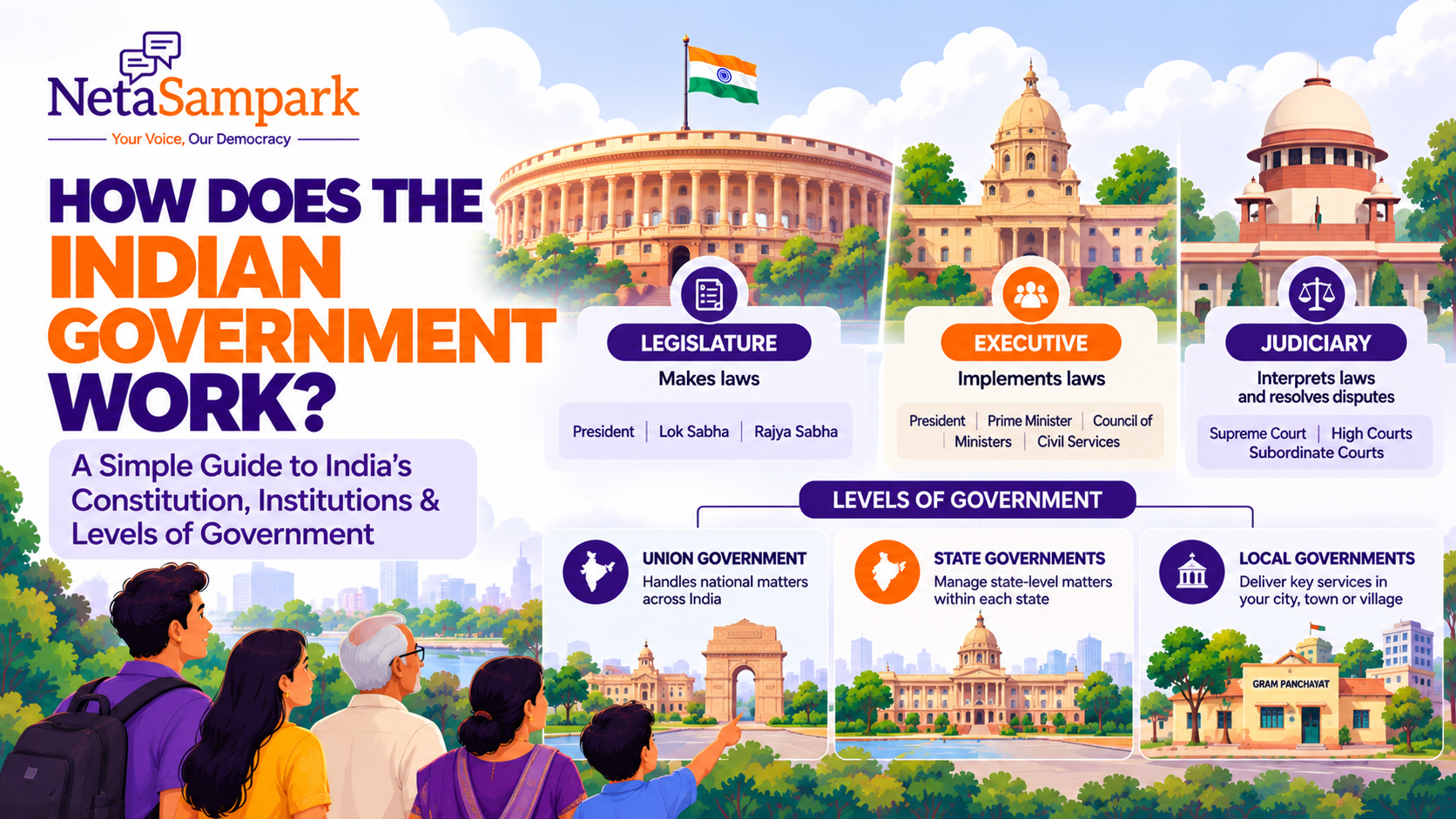
Most public problems fall into one of five categories.
Type of problem
First point of contact
Local civic services
Municipal corporation, municipality, panchayat or relevant local service provider
State government services
Relevant state department, district administration or designated grievance authority
Union Government services
Relevant Union ministry, department or service provider
Crime or immediate danger
Police or emergency services
Information about government records
Relevant Public Information Officer under the applicable Right to Information (RTI) process
The responsible authority depends on the service, the location, the ownership of the infrastructure and the applicable law. For example, a road may be maintained by a municipality, a state public works department or a national highway authority.
Do not assume that every problem in your neighbourhood is the responsibility of your MLA or MP. Identifying the correct authority is often the fastest way to get a response.
2. Who should you contact for common problems?
Use this table as a practical starting point. The first authority listed is generally the most relevant starting point, but local arrangements can differ.
Problem
Whom to contact first
When to escalate
Potholes on a local street
Municipal corporation, municipality or panchayat, depending on the road
Relevant engineering department, commissioner or designated grievance authority
Damaged state highway
State road-owning agency or Public Works Department (PWD)
Department's senior engineer or grievance authority
Damaged national highway
National Highways Authority of India (NHAI) or the responsible highway authority, depending on the road
Relevant regional or senior authority
Garbage not collected
Municipal sanitation department or panchayat
Sanitation officer, municipal commissioner or designated grievance channel
Blocked stormwater drain
Local body or the agency responsible for the drain
Engineering department or designated grievance authority
Irregular municipal water supply
Local water utility or municipal water department
Senior utility official or the relevant state water authority
Electricity outage or billing dispute
Electricity distribution company
Its grievance mechanism and, where applicable, the Electricity Consumer Grievance Redressal Forum and Electricity Ombudsman
Broken streetlights
Local body or the agency maintaining the lights
Relevant engineering or maintenance officer
Government school issue
School head, relevant education authority or state education department
Block, district or state education grievance channel
Government hospital service issue
Hospital administration or designated grievance officer
District health authority or state health department
Delay in a state welfare benefit
Scheme's implementing office or relevant state department
District scheme officer or state grievance mechanism
Delay in a central government benefit
Scheme's implementing office or relevant Union department
Department grievance mechanism or CPGRAMS, where applicable
Police complaint not acted upon
Appropriate police station or senior police authority under the applicable procedure
Designated senior police officer, police grievance mechanism or appropriate legal remedy
Online financial fraud
Call 1930 immediately and report through the National Cyber Crime Reporting Portal
Follow the portal and police process; notify the bank or payment provider promptly
Consumer complaint against a business
Seller or service provider, followed by the National Consumer Helpline or appropriate consumer commission
Use the applicable consumer grievance and legal process
Voter registration or electoral-roll issue
Election Commission's voter services and the relevant electoral registration authority
Contact the designated election officer or use the official voter helpline
Request for government information
Relevant Public Information Officer under the RTI Act, where applicable
First appeal and subsequent statutory remedies, if required
For general public-service grievances involving Central or State Government organisations, the Centralised Public Grievance Redress and Monitoring System (CPGRAMS) provides an official route to submit and track eligible complaints.
3. Should you contact your MLA, MP, MLC or corporator?
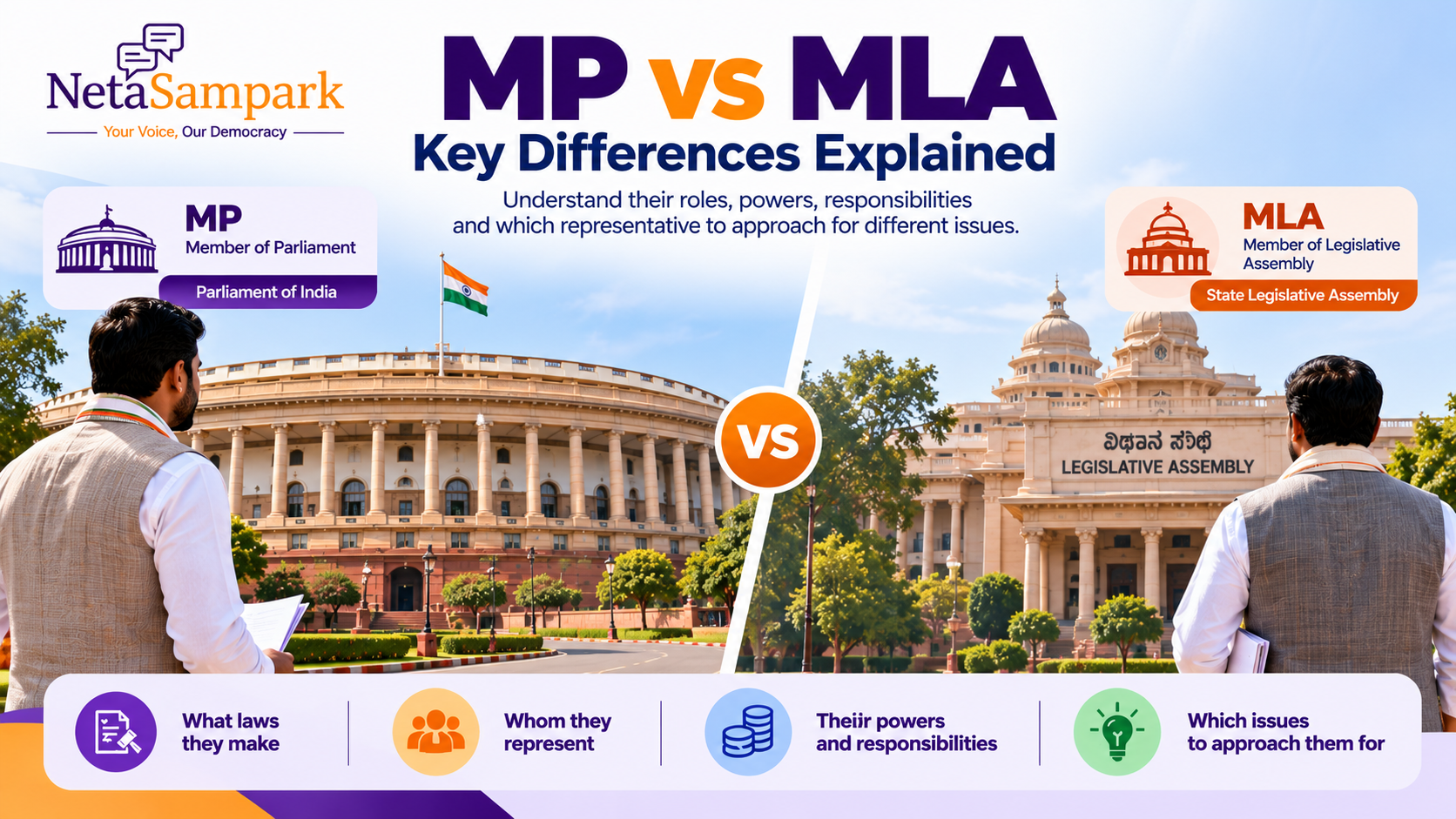
Elected representatives can help citizens raise concerns, request follow-up and bring recurring public problems to the attention of the appropriate government authority. Their roles, however, are different.
MLA — Member of the Legislative Assembly
An MLA represents an Assembly constituency in the State Legislative Assembly.
Consider approaching your MLA when:
A state government department has not addressed a recurring problem.
You want to raise a concern about state policies or public services.
A local issue requires coordination with state-level authorities.
You want your concern raised through legislative or other appropriate channels.
An MLA can advocate for action, but cannot independently approve every project, guarantee a benefit or exercise unrestricted control over government departments.
Read the related guide: What Does an MLA Do? Roles, Responsibilities and Powers Explained.
MP — Member of Parliament
An MP serves in Parliament and participates in national lawmaking and scrutiny of the Union Government.
Consider approaching your MP when:
The issue concerns a Union Government ministry or service.
A railway, national highway or other centrally administered service is involved.
A central government scheme or policy concern requires escalation.
A matter needs to be raised with an appropriate Union authority.
The relevant service provider or government department remains responsible for handling the complaint. An MP can help bring the issue to its attention but does not personally administer every central service.
Read the related guide: What Does an MP Do? Roles, Responsibilities and Powers Explained.
MLC — Member of the Legislative Council
An MLC serves in the upper house of a state legislature in states that have a Legislative Council.
An MLC may help raise state-level policy concerns, examine government performance through legislative procedures and bring public issues to the attention of the appropriate authority.
An MLC does not necessarily represent a territorial constituency in the same way as an MLA. Their method of selection and representative role depend on the category of seat.
Read the related guide: What Is an MLC? Meaning, Election, Powers and Responsibilities Explained.
Corporator or councillor
A municipal corporator or councillor represents a ward in an urban local body, where the relevant elected structure exists.
Consider approaching your ward representative for issues such as:
Local sanitation and waste collection.
Streetlights and neighbourhood infrastructure.
Local drainage and civic maintenance.
Ward-level public-service concerns.
The precise responsibilities depend on the local body's powers, the relevant service agency and the city's administrative structure.
Panchayat representative
In rural areas, the relevant Gram Panchayat and its elected representatives may be the appropriate starting point for local civic services, depending on the function and how responsibilities are assigned in that state.
Issues involving roads, drinking water, sanitation or local public facilities may be handled by different tiers of rural local government or by state departments.
Important: An elected representative can be an escalation channel, but the department or public authority legally responsible for a service is usually the body that must take the administrative action.
4. How to identify the correct department
If you are unsure who owns a road, manages a water connection or administers a public service, follow these steps.
Step 1: Identify the type of service
Ask whether the problem concerns a local civic service, a state department, a Union Government service, a private service provider or an emergency.
Step 2: Identify the service provider or asset owner
Check the name of the utility, department, authority or local body responsible for the service. A road's ownership, for example, may determine which agency maintains it.
Step 3: Check the official website
Look for sections labelled:
Grievance Redressal
Citizen Services
Contact Us
Public Complaints
Department Directory
Complaint Status
Use official government websites and verified contact details rather than relying on unverified phone numbers circulated on social media.
Step 4: File a complaint through the designated channel
Describe the issue, provide the location and attach supporting evidence where relevant. Keep the complaint or acknowledgement number.
Step 5: Escalate if the issue remains unresolved
Follow the department's escalation process. If the matter concerns a government service and is eligible for the centralised grievance system, CPGRAMS may provide an additional route.
5. Where can you file a complaint online?
The following are official channels for specific purposes. They do not replace every state or local grievance system.
Use it for eligible grievances concerning Central Government ministries, departments and State Government organisations. You can lodge a complaint, track its status and use the available appeal facility when applicable.
[Open the CPGRAMS portal](https://pgportal.gov.in/) <Cite refs={["turn924661search2","turn924661search6"]}/>
</box> <box border radius="lg" padding={3} gap={1}> **National Cyber Crime Reporting Portal**
Use this portal to report cybercrime. For online financial fraud, call **1930 immediately** and complete the reporting process through the official portal. Prompt reporting can be important when attempting to limit financial loss.
[Report cybercrime](https://www.cybercrime.gov.in/) <Cite refs={["turn762211search3","turn762211search10"]}/>
</box> <box border radius="lg" padding={3} gap={1}> **National Consumer Helpline**
Use it for consumer grievances involving goods and services. The official helpline is **1915**, available from 8 AM to 8 PM, except national holidays, according to the Department of Consumer Affairs.
[Open the National Consumer Helpline](https://consumerhelpline.gov.in/) <Cite refs={["turn924661search12","turn924661search14"]}/>
</box> <box border radius="lg" padding={3} gap={1}> **Election Commission voter services**
Use official voter services to check electoral-roll information, polling details and other election-related services. The Election Commission lists **1950** as the voter helpline; add your STD code where required.
[Open the Election Commission of India website](https://www.eci.gov.in/) <Cite refs={["turn924661search11"]}/>
</box> <box border radius="lg" padding={3} gap={1}> **Emergency Response Support System**
For an immediate emergency involving danger to life or safety, call **112**. Do not wait for an online grievance or a response from an elected representative.
[Learn about emergency number 112](https://www.112.gov.in/about) <Cite refs={["turn924661search3","turn924661search8"]}/>
</box> </box>
For local civic complaints, use the official website or complaint mechanism of your municipality, municipal corporation, panchayat or responsible utility. These channels vary across states and cities. The National Government Services Portal can help you discover government services and grievance facilities. <Cite refs={["turn762211search12","turn924661search0"]}/>
6. What if your complaint is not resolved?
A complaint should not end with a submission number. Follow the applicable escalation process.
A practical escalation sequence
Contact the responsible office. Submit the complaint through its official channel.
Keep the acknowledgement. Save the reference number, date and supporting documents.
Follow up with the designated officer. Use the department's published escalation procedure and timelines.
Escalate to the next authority. This may be a senior department official, district-level authority, grievance officer or statutory forum, depending on the issue.
Use the appropriate government grievance portal. CPGRAMS may be available for eligible Central or State Government service grievances.
Approach your elected representative if useful. Your MLA, MP, MLC or ward representative may help bring the unresolved issue to the responsible authority's attention.
Consider statutory or legal remedies where appropriate. Some disputes require a specific appeal, tribunal, consumer commission, court or other legally prescribed process.
There is no single escalation ladder for every problem. A consumer dispute, police complaint, electricity grievance and request for information may have different statutory procedures.
How does CPGRAMS work?
CPGRAMS is a centralised online grievance platform connected to participating Central Government ministries and departments and State Governments.
According to the official portal, citizens can submit eligible grievances, track them using the registration ID and access an appeal facility where available. The portal also lists categories it does not take up, including RTI matters and court-related or sub judice matters. Check the portal's current eligibility and exclusions before filing. <Cite refs={["turn924661search2","turn924661search5"]}/>
7. When should you contact the police instead of a politician?
If a problem involves a crime, threat, violence, theft, assault or immediate danger, contact the police or emergency services through the appropriate official channel.
Do not wait for an MLA, MP or other representative to intervene before seeking urgent assistance.
For an emergency, call 112. For cybercrime, use the National Cyber Crime Reporting Portal; for online financial fraud, call 1930 promptly. The cybercrime portal specifically directs people to local police for emergencies or crimes outside its cybercrime reporting scope. <Cite refs={["turn924661search3","turn762211search8"]}/>
A representative may help raise concerns about police administration or follow up through appropriate channels, but elected representatives do not replace the police investigation process or the courts.
8. What if you only need information, not a complaint?
A request for information is different from a grievance.
For example:
“Why has my application not been processed?” may be a service grievance.
“Please provide a copy of the order approving this project” is a request for an existing record.
“What action has been taken on my complaint?” may be pursued through the relevant grievance channel or, where appropriate, an RTI request.
The Right to Information Act, 2005 provides a statutory mechanism to seek information held by public authorities, subject to the Act's provisions and exemptions.
For an RTI request, identify the relevant public authority and its Public Information Officer. If you are dissatisfied with the response or receive no response within the applicable period, the Act provides first-appeal and further appeal mechanisms.
Do not use CPGRAMS as a substitute for an RTI application. The CPGRAMS portal explicitly excludes RTI matters from its grievance redressal scope. <Cite refs={["turn924661search2","turn924661search5"]}/>
9. How to write an effective public grievance
A clear, factual complaint makes it easier for an authority to understand the problem and determine the appropriate action.
Include the following:
Subject: A short description of the issue.
Location: Exact street, ward, village, facility or service location, as relevant.
Description: What happened, when it started and how it affects the public.
Previous action: Any earlier complaint numbers, dates or responses.
Evidence: Photographs, receipts, application references or relevant documents.
Requested action: State what you want the authority to inspect, clarify, repair or review.
Contact details: Provide the information required by the official complaint channel.
Avoid unsupported accusations, abusive language and unnecessary personal information. Keep copies of submissions and do not share sensitive documents publicly unless necessary.
Example: A damaged local road
Subject: Request for repair of damaged road in [area or ward]
Complaint:
The road near [specific location] has developed significant potholes, creating difficulties for commuters and a potential safety risk. The issue has been observed since [date, if known].
Please arrange an inspection and take appropriate action to repair the damaged stretch. Photographs and the exact location are attached for reference.
If this road falls under another authority, kindly direct the complaint to the responsible department or provide the appropriate contact details.
Previous complaint reference: [Insert number, if applicable]
Requested action: Inspection, repair and an update on the action taken.
Submit this complaint to the authority responsible for maintaining the road. If it remains unresolved, follow the authority's escalation process and consider approaching your ward representative or MLA for assistance.
10. Common mistakes citizens should avoid
Contacting the wrong representative
A local drainage issue may be handled by a local body, while a railway service issue belongs to a different authority. Identify the responsible agency before escalating.
Relying only on verbal complaints
A conversation may help, but a written or officially registered complaint creates a record you can refer to during follow-up.
Assuming a politician can directly order any action
Representatives can advocate, raise concerns and seek responses. They do not have unlimited administrative or legal powers.
Using a grievance portal for every kind of dispute
RTI requests, court matters, consumer disputes, police complaints and public-service grievances can require different channels. Check the scope of the portal before filing.
Sharing incomplete or unverified information
Provide accurate dates, locations and supporting evidence. Avoid forwarding unverified allegations or publishing other people's personal information.
Giving up after the first response
Read the response carefully. If the issue remains unresolved, use the applicable appeal or escalation procedure instead of repeatedly filing identical complaints without referring to earlier records.
Frequently asked questions
Should I contact my MLA or MP for a local problem?
Start with the department or local body responsible for the service. If the problem remains unresolved, your MLA or MP may help raise it with the relevant authority, depending on the issue and their role.
Who is responsible for roads in India?
Responsibility depends on the road. Local streets may be maintained by municipal bodies or panchayats; state roads may fall under state agencies; national highways may be managed by NHAI or another designated authority. Confirm the road's ownership before filing a complaint.
Can I complain directly to the Chief Minister or Prime Minister?
Some states provide official Chief Minister grievance mechanisms, and the Government of India provides a PMO grievance portal. However, the appropriate channel depends on the issue and the portal's scope. A complaint may be referred to the department responsible for resolving it. <Cite refs={["turn762211search14","turn924661search2"]}/>
What should I do if a government office ignores my complaint?
Keep the complaint reference and use the department's escalation mechanism. Depending on the issue, you may approach a senior officer, grievance authority, statutory forum or eligible government grievance portal. An elected representative may also help escalate the matter.
Can I use CPGRAMS for a municipal complaint?
CPGRAMS covers eligible grievances concerning Central Government ministries, departments and State Government organisations. Whether a particular municipal complaint is appropriate for the portal depends on the organisation and the portal's current scope. A local body's own grievance channel may be the more direct starting point.
What is the difference between a complaint and an RTI application?
A complaint asks an authority to address a problem or grievance. An RTI application seeks information held by a public authority, subject to the Right to Information Act. They serve different purposes and use different procedures.
What should I do in an emergency?
Call 112 for emergency assistance. For online financial fraud, call 1930 promptly and use the official cybercrime reporting portal. Do not delay urgent action while waiting for an elected representative or a routine grievance response. <Cite refs={["turn924661search3","turn762211search3"]}/>
Key takeaway
The most effective way to resolve a public problem is to identify the responsible authority, submit a clear complaint, retain the reference number and follow the correct escalation process.
Local civic issue: Contact the responsible municipality, panchayat or service provider.
State government issue: Contact the relevant state department or grievance authority.
Union Government issue: Contact the relevant ministry, department or service provider.
Crime or emergency: Contact the police or emergency services.
Government information: Use the applicable RTI process.
Unresolved public-service grievance: Escalate through the relevant official channel and consider seeking help from your elected representative.
Your MLA, MP, MLC or local representative can be an important part of the process, but knowing which institution is responsible helps you direct your concern to the right place.
Know. Ask. Participate. Your voice. Your representatives. Your democracy.
Find your representative on NetaSampark and learn how to raise public concerns through the appropriate channels.
Official references
CPGRAMS — Centralised Public Grievance Redress and Monitoring System: https://pgportal.gov.in/
National Government Services Portal: https://services.india.gov.in/
Emergency Response Support System — 112: https://www.112.gov.in/about
National Cyber Crime Reporting Portal: https://www.cybercrime.gov.in/
National Consumer Helpline: https://consumerhelpline.gov.in/
Election Commission of India: https://www.eci.gov.in/
National Portal of India — Government services and helplines: https://www.india.gov.in/
This guide is for general civic education, not legal advice. The authority responsible for a service, complaint procedures and escalation routes can vary by state, local body and the applicable law. Always verify current details on the relevant official website.